
"coffee consumption stats"
146000 article(s) found
International Coffee Organization reports that tea and coffee consumption in Arab countries has more than tripled
According to the latest statistics released by the International Coffee Organization, tea and coffee consumption in Arab countries has more than tripled in the past decade. Consumption in the United Arab Emirates has increased by 85% in the past three years. The per capita annual consumption of tea and coffee in the United Arab Emirates is 3.5 kg, which is about double that of other Gulf countries, and tea consumption has increased by 47%. 2011 Global Coffee

Tea and coffee consumption in the United Arab Emirates has increased by 85% in the past three years.
According to the latest statistics released by the International Coffee Organization, tea and coffee consumption in Arab countries has more than tripled in the past decade. Consumption in the United Arab Emirates has increased by 85% in the past three years. The per capita annual consumption of tea and coffee in the United Arab Emirates is 3.5 kg, which is about double that of other Gulf countries, and tea consumption has increased by 47%. 2011 Global Coffee

Drinking coffee increases the risk of ovarian cancer death?
Following Cafe Review (Wechat official account vdailycom) found that Beautiful Cafe opened its own shop and the world consumes 2.25 billion cups of coffee a day. Many articles based on small studies have shown that the bioactive substances in coffee play a positive role in reducing inflammatory levels, insulin antagonism and the risk of diabetes. Recently, large-scale studies, mainly in the United States, have reported that more coffee consumption and
Emerging countries account for 20% of the world's coffee consumption.
According to Brazil's "World wide Web", emerging countries represented by China, Brazil, Russia, India and South Africa currently consume 20% of the world's coffee, which will reach 35% by 2020. According to analysis, the increase of the middle class in these countries is an important factor driving the growth of coffee consumption.
Emerging countries account for 20% of the world's coffee consumption.
Emerging countries, represented by China, Brazil, Russia, India and South Africa, currently consume 20 percent of the world's coffee and will reach 35 percent by 2020, according to the website of the Ministry of Commerce. According to analysis, the increase of the middle class in these countries is an important factor driving the growth of coffee consumption. The International Coffee Organization (Portuguese abbreviation OIC) estimates

It is controversial that coffee shops in Jinan charge minimum consumption.
Once you step into a coffee shop, you can't leave without paying. Is this a reasonable rule? Recently, at the British Royal Coffee Restaurant on Sunshine New Road, Mr. Zhang and several colleagues sat for 15 minutes, during which they drank eight glasses of water without any consumption, and were charged a service charge of 30 yuan. After visiting several coffee shops in Jinan, the reporter found that charging for guests entering the door has almost become the rule of the coffee shop. According to the price department, coffee

China's coffee consumption market will usher in a new era of "street coffee"
Professional baristas please follow the coffee workshop (Wechat official account cafe_style) data source: according to Chinanews.com, as an international trade commodity, coffee was produced in the world by about 8.5 million tons in 2015, with major coffee-producing countries such as Brazil accounting for 70 per cent of global coffee production. The scale of the global coffee consumption market is about 12 trillion yuan, with annual consumption.

Analysis of China Coffee Franchise Market in 2014
After entering the 21st century, the rapid growth of China's economy, the continuous improvement of people's quality of life, the increasing diversification of drinks, coffee gradually linked with fashion and modern life have led to a rapid increase in coffee consumption, forming a huge consumption potential market.

Coffee consumption market annual growth of 25% hand-washed grinding will be more popular
As consumers 'coffee consumption tastes are getting higher and higher. Consumers are beginning to recognize the brand, style and purity of coffee and want to enjoy coffee. The popularity of office and home coffee machines provides convenient conditions for consumers to consume coffee beans. In addition, large coffee chains have entered China, such as Starbucks, CAFFE PASCUCCI, Shangdao, Man Coffee, etc.

The new market mode of the coexistence of "street coffee" and "business coffee" opens the coffee consumption market.
Professional baristas Please follow the coffee workshop (official Wechat account cafe_style) with the economic development, the consumption pattern of our country is in the stage of upgrading. Beverage consumption has changed from functional to enjoyable, and consumers have begun to pay attention to consumer taste, which brings huge market opportunities for coffee consumption. According to statistics, the annual per capita coffee sales in Europe and the United States is 500 cups.
Coffee consumption in China is growing by more than 40% a year.
It is reported that in recent years, China's coffee consumption has risen sharply, with an annual growth rate of more than 40%. It has become an important engine of global coffee consumption and attracted the attention of the world. In 2003, China's total coffee consumption was 19080 tons, double that of 1995, with an annual growth rate of 14.9%. The annual per capita consumption was 14.7g, 0.18% of that of Europe, 0.35% of that of the United States and 0.4% of Japan.
Compared with cafes, will China's next Starbucks be born from tea brands?
Exchange of professional baristas Please pay attention to the Coffee Workshop (Wechat official account cafe_style) the new tea combines traditional Chinese tea and milk tea, creating a wonderful chemical reaction, followed by a frenzy of capital. Its purpose is simple and pure, hoping to break down the barriers to brand culture and consumer concepts, and then find the next Starbucks in it. Eye

Will the next Starbucks appear in the field of "new tea" when tea is hot?
Can the market size of the tea industry accommodate the next Starbucks? What is the key to the birth of the next Starbucks in a new tea shop? Although we use the above space to demonstrate the scale and potential of China's tea market, the existence of the market does not necessarily mean that there will be monopolistic oligarchs in this industry, and there are also many industries with a huge market, such as Chinese catering.

Hot! The consumption of Chinese coffee market is expected to reach 300 billion yuan in 2020!
In recent years, there have been a lot of comments on China's coffee market. How big is the consumption of China's coffee market in the future? Some experts pointed out that by 2020, the consumption of China's coffee market is expected to reach 300 billion yuan! Wang Caihua, a senior research and management expert in China's coffee industry and deputy director of the coffee shop standardization promotion management committee, said: according to relevant industry data, Chinese coffee

The increase of national income is expected to increase the per capita consumption of coffee.
The improvement of China's national income level is expected to lead to the increase of coffee consumption per capita. The market penetration of the young and middle-aged population helps to drive the growth of potential coffee consumers. As a drink with unique taste, coffee is very popular among young and middle-aged people. The survey shows that different age groups in China have different degrees of love for coffee, among which people aged 41-50 account for 24% of the total.
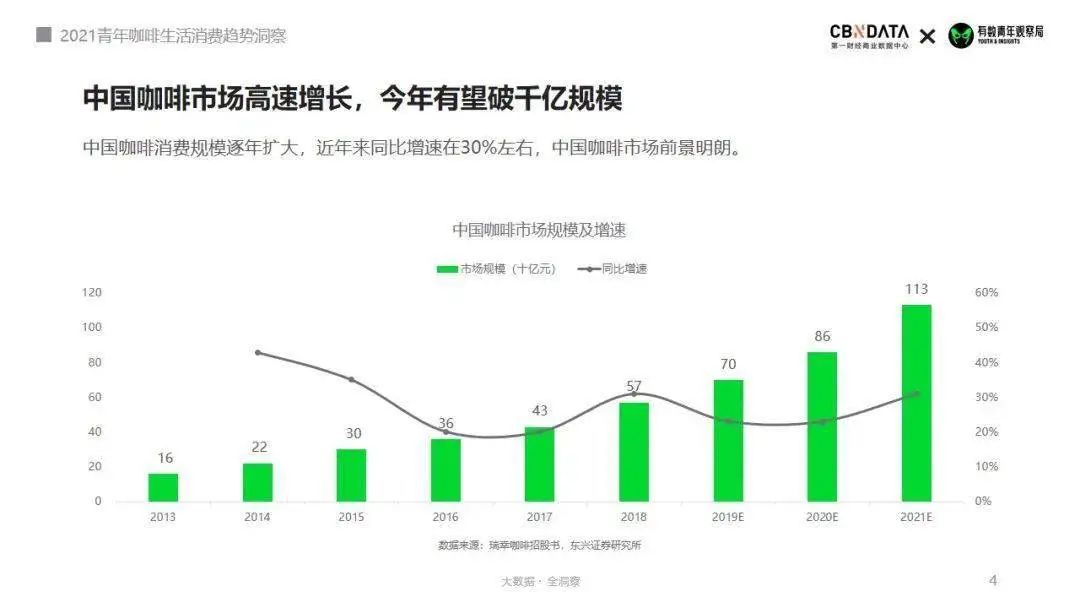
The Development Prospect of Coffee in China ranking of per capita Coffee consumption in Beijing, Guangzhou and Shenzhen
China's coffee market is in a stage of rapid development, and the consumption trend in recent years also confirms this. In addition, with the expansion of the coffee market, capital pays more and more attention to coffee brands, with the blessing of various factors, the coffee track is becoming more and more crowded. On May 28th, the first Financial and Economic data Center (CBNData) jointly with the Youth Observatory released a copy of "2021 Youth Coffee"

China's coffee consumption will reach trillions ten years later
At present, the Chinese coffee consumption market is still small, but the growth momentum is very considerable. The Expo not only attracted the exhibitors of Brazil, Ecuador and other major coffee producing countries and coffee manufacturers, but also organized a delegation to participate in the exhibition for the first time in Pu'er City, Yunnan Province, with the slogan "Coffee Capital of China". It has formed a new situation of competing for "beans" between domestic coffee beans and countries of origin of coffee beans all over the world.
